
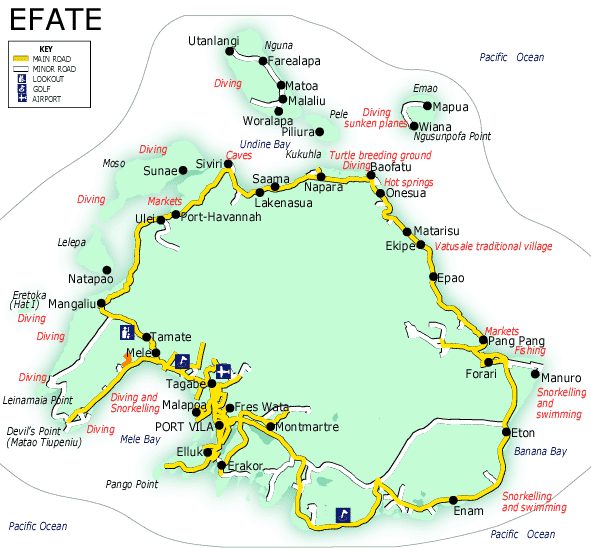
The name used for the language I will report on is South Efate, since the language is used in the southern part of Efate (an island of Vanuatu). Villages that speak it include Pango, Erakor, and Epau. By its speakers it is also called "nafsan" which translates as "language" or "story" (Thieberger, p1). In one 1983 survey (Ethnologue, online version) there were estimated to be 3,750 speakers of South Efate, with the language considered to be "at risk" (Thieberger, p44) and no longer being taught in elementary or secondary schools.
South Efate is generally considered to be descended from Proto-Central Vanuatu, related to other Southern Vanuatu languages and ultimately belonging in the Eastern Malayo-Polynesian branch of the Austronesian Language Family (Grammar of South Efate, Ethnologue online).
In my research I actually found one book source that claimed Efate was descended from the Semitic Language Family (Macdonald, Daniel: The Oceanic languages, their grammatical structure, vocabulary, and origin), but this seems unlikely if there are language similarities between South Efate and South Vanuatu, and also considering what our class has studied about Austronesian population migrations.
One interesting grammatical feature of South Efate is the way it shows actions. The mood of a verb can be marked either as realis (something that is a fact and really happened), irrealis (something which may not have happened, or may hypothetical), or perfect (a completed action), depending on the particle you use before the verb (Thieberger, pp148-152). However, past, present, and future are not marked grammatically (as in English, for example). If you need to give more information about an action's time frame in South Efate, people use words like "as" (day after tomorrow), "malpei" (before), and "tetwei" (long ago), etc. to indicate when the thing occurred.
The very first publication in South Efate was titled "Nadus iskei nig Fat", and printed in 1864 (Thieberger, p33). It was a seven page booklet of Biblical material, and most of the following books or pamphlets printed in South Efate were also Christian in topic, put out by missionaries. However, in an attempt to make the books more "accessible" to people on Efate, the South Efate language was mixed with other languages of Efate.
The speech community of South Efate has been negatively affected by the immigration of populations to the coastlines, with one survey showing that 5-10% of primary school students in Erakor village do not speak the language (Thieberger, p43). Bislama, the version of Melanesian pidgin language used on Efate and also the national language, is used everywhere, especially by people who travel and intermarry with other language-speakers.
One guidebook to Efate, compiled by the Lycée d’Enseignement Professionnel (New Hebrides, Efate, p99) mentions only Bislama, French, and English as being spoken, and does not even name Efate's other languages at all. However, as of 2006, South Efate is not yet at risk of disappearing "in the immediate generations of speakers" (Thieberger, p44).
Image source:
Vanuatu Travel Information. Antor.org. http://www.antor.org/vaninfo.html. Accessed online: February 12, 2009.
Other Sources:
Thieberger, Nick. A grammar of South Efate : an oceanic language of Vanuatu. Honolulu : University of Hawai'i Press, c2006.
Macdonald, Daniel. The Oceanic languages, their grammatical structure, vocabulary, and origin. New Delhi : Asian Educational Service, 1997.
New Hebrides, Efate : [guide book]. Thomas, Andrew (ed.) Port-Vila : LyceÌe Professionnel, 1978.
"South Efate." Gordon, Raymond G., Jr. (ed.), 2005. Ethnologue: Languages of the World, Fifteenth edition. Dallas, Tex.: SIL International. Online version: http://www.ethnologue.com/. Accessed online: February 7, 2009.

No comments:
Post a Comment